Wednesday, September 21

Winning? Not Today.

Le sigh. There's no winning.

Okay, so a few things about today's changes on Facebook. No doubt you've heard the complaints, the irritation, the rants, the vents, the general goings-on. If you didn't, you might be the only person on the planet - or you're not online.

I get that it's new. I get that it's different. I get that you liked "the old way". I get that you now have to "learn this". But seriously...c'mon, people. Think about this, as said beautifully by this someecards card:
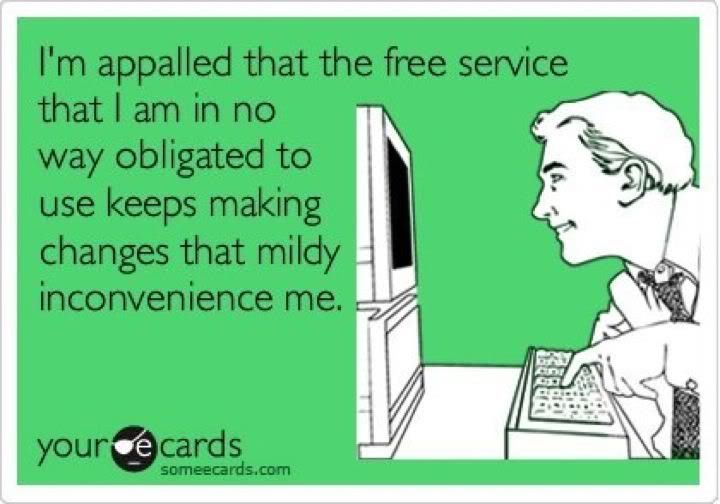

Here's the thing: Facebook can't win with everyone. Think of it like road construction; we all bitch, moan and whine that it needs to be done - the potholes are terrible, they're eating our car, the government needs to fix this - and then we bitch, moan and whine when it's being done - it's an inconvenience, it makes our travel time longer, it's a pain to sit and wait. Let's be honest here, shall we? If the Facebook of September 21, 2011 looked exactly like and performed exactly like the Facebook of September 21, 2008, we'd all scream and curse and rant and rave that it was "behind the times", "outdated" and we'd ask what in the name of all things techie they were doing in those offices.

If you'd like to see a perfectly good example of what happens when a company stops innovating, take a look at RIM. There are many news stories out there all clearly illustrating that lagging behind has hurt this company more than anyone could have believed. Other companies moving ahead and doing new things that delight and captivate their customers means that the lack of the same at RIM is highlighted fantastically - though not so much for them. When they released their new lineup of phones just a few weeks ago, there were loud cries of "Too little, too late!" - I'm 150% certain that's not the reception they dreamed about the night before launch.

Maybe it's because I'm very much an online person, but I embrace changes like these. Facebook employs an entire team of developers and creative minds whose sole purposes with the company is to innovate and create change. As of July 2011, Facebook has more than 750 million active users. I find it pretty impossible to even suggest that a company that has amassed that sort of user-base doesn't know what it's doing. Even if you're not a fan of the platform, I think it's safe to surmise that they've got a grip on what's going to make their product better or worse. Maybe they could make their plans a little more publicly known, sure - but as I said to a friend (on Facebook, no less), why should they bother? They're not going to drop from 750 million users down to 14 individuals because they didn't hold a press conference before rolling out changes. People will adapt, the same as they always do, and in a week's time no one will remember what September 20, 2011's Facebook looked or behaved like.

The changes are here. Why not spend time getting to know them, find out what's nifty, helpful, interesting or new and embrace them? That's what I'll be doing.

What are your thoughts? Should we expect a message every time a free service/platform upgrades? I'd love to know what you think!

Thursday, September 15

Brilliant or Insane? Game On!

There comes a time in your life where you take yourself by the hand, walk yourself down a scary little path into a shadowy, wooded area and say, "Okay now, Self...it's time to take the next step." Then comes the fun part - watching to see whether you'll take the step, or run screaming back into the light. (I make it sound joyous, no?)

That scary walk happened this week for me - I've started a new venture. Whether or not it'll work, only time will tell. Whether or not I've completely lost my mind, only time will tell. Whether, as the title of this post asks, I'm brilliant or insane, only time will tell. Obviously I'm hopeful that I'm brilliant, but if I'm completely honest there's a pretty good chance I'm certifiable.

I recently read a blog post by the awesome Lindsay Bell that rattled me to the core. Not because she's a fantastic writer (which she is) or because the topic was fantastic (which it was), but because the timing of it couldn't possibly have been better had she said, "Hey Tab - what do you think I should write about that would reach out and touch your brain?" Her post is about being comfortable with being uncomfortable - something many of us simply hate even attempting - and why it's important to take those little journeys.

For me, planning the trip isn't hard. Talking about the trip isn't hard. Getting my shoes on to walk the path isn't hard. Dropping myself off outside of that shadowy, wooded area and saying "Okay....go!!"...that's hard. I almost wish I could halve myself - at least then I'd be able to give myself a push, right? Alas, I have to stare into that shadowed, scary area and say to myself, "Alright...let's do this."

I've done it. I've started what may or may not be the coolest, greatest, most fun and brilliant thing I've ever done, or the craziest, off-the-wall, most insane thing I've ever done. Right now, I have no idea which it is. Am I comfortable being uncomfortable? I'd love to tell you "Hell yes I am!", but I'd be lying. Right now I'm more in a place of "Okay, the first step has been taken. Let's just get some footing and see how the next step forward feels." However, and this is the part that I think is really cool, I'm on the path to getting there.

But you know what? That's a lot further than I was yesterday. :)

Thanks, Lindsay - you've been a great source of inspiration and believe-in-myself the last few months. Pretty good for someone I've never met, huh? 

Friday, April 15

Tips From A Pro - Lucky Me!

Talk about fun! During a recent B2B blogging webinar provided through MLT Creative, I was lucky enough to have a question answered by Mark Schaefer, owner of {grow} - if you haven't checked it out, do yourself a favour and do so.

I've recently started a company blog for Sandy Bay Networks, the fantastic company that employs me, and wanted to ask Mark for some tips on doing so. He put together a fantastic blog post to answer my question, and I'm really excited to have someone so experienced and well-known in the blogging and marketing world give their input. Thanks, Mark!

To read Mark's blog, and maybe even help your own blog start-up be that much easier, check it out: http://www.businessesgrow.com/blog/

Sunday, March 20

How Does Your Community Grow?

When I hear the phrases “engaging community members” and “building community” used, I can’t help it: my ears perk up a little. Having spent over a decade immersed in online communities – both business and non-business related – I feel I’ve got a pretty decent handle on what works and what doesn’t.

My concern these days? I feel like we’re forgetting the basics. I’m all for engaging the members in your community, I’m all for interacting, and I’m all for encouraging conversation. However, I think we’re being a little full of ourselves to think that simply doing these things make a community thrive. The fact of the matter is, communities are more than just words on a website. They require real connections to be made – simply being there isn’t enough. Without relationships and interaction beyond “Tell us what you think of us!” you have little more than an online suggestion box.

Over the years I’ve been lucky enough see a number of “sides” of online communities. I’ve been a new member, I’ve been a volunteer community leader, I’ve been a community moderator…I’ve done it all. One thing I’ve watched happen time and time again is a community dying due to lack of relationships forming. On the other hand, I’ve also watched relationships form and bloom countless times. The difference in the atmosphere of the communities is astonishing; one is cold and stark, the other jubilant and engaging all of its’ own accord. To further illustrate my point, take this into consideration: in 2002 I was pregnant with my youngest son and joined an “Expecting Club” community. I’m proud to tell you that I am still in contact with a large number of these women on a daily basis and consider them some of my best friends. Without the formation of relationships, of solid connections, these communities wouldn’t be a part of my life I look upon fondly.

Obviously online communities in the business world have differences from personal on non-business communities, but I think that the basics of what make them work stand true. Unless you’re willing (and able) to provide a massive amount of incentives for post counts or answering surveys, ensuring that your community has something to keep people coming back is essential. Without members, you have no community, plain and simple. Sure you can continually invite and market yourself, but my question is this: Would you rather have the opinions of 1500 people who all visited your community once for the free t-shirt, or the opinions of 150 people who have put some serious time, thought and effort into relaying to you what they really think? The better the relationships you develop the more honest and open your members are willing to become. A major pitfall of those 1500 one-time visitors is that the opinions you’re going to hear are going to be mostly positive – they want to ensure they get the incentive. While the number may look better, the data you’re collecting isn’t going to be nearly as beneficial to your business or organization.

My advice to anyone, whether on a personal or professional level, interested in starting an online community? Make sure you’re willing to put the time into handling it properly. Hire the right people to moderate it, and don’t fall into the trap of thinking that great community management/moderation comes easily or cheaply. Don’t expect that the same person who manages communities aimed at men will be as successful at managing those aimed at children. If you’re lucky this is the case, but remember that it’s not going to be the general rule.

Communities thrive when they’re allowed and encouraged to do so. This is a fundamental truth we should all keep in mind. Now go out and foster those connections!

Monday, February 28

May I Help You?

I'm not afraid to ask for help. I have always been the sort of person who knows when something is beyond my capabilities and knows that there comes a time for each of us when the words "Can you help me with this?" just have to be asked. I remember being a little kid and struggling with the zipper on a jacket and realizing "I need help!" but was too stubborn to ask - I waited until my frustration level was too high and broke it. Lesson learned. Waiting too long to ask sometimes has results we're not happy with.

Over the last few years, I've realized that knowing when to ask for help is only one part of the issue. Knowing how to ask for help is often the part we get stuck on. No matter how badly we need assistance, if we ask in a way that isn't conducive to receiving it, we're still in a bind.

You've been in the situation, I'm sure: Someone asks you, completely exasperated, "Can you just help me??" Yes, they're exasperated. Yes, they're struggling. Yes, you want to help. It's really difficult to help someone who's already reached the "I hate this!" stage, though. They don't listen as well, they're probably argumentative, they're thoroughly frustrated with the entire situation, and you know going into it that harsh words are a good possibility. It makes helping a chore instead of a pleasure.

Regardless of what you're doing, whether it's at work, at home, in a social setting, is to take a step back. Breathe. Count to ten. Do whatever you have to do to be in the right state of mind to ask for and accept help. Remember - when you ask for help, you're about to learn something. Your way of going about the problem wasn't successful, and you're looking for another viewpoint. Realize that it's not going to be the way you'd do things - you've already tried that avenue. Be open to learning. Be open to suggestions. Accept that there is another way - and accept that by learning that way, you're not only fixing a problem, you're also opening your mind to another way of thinking.

No, I don't get asking for help "right" every time. I'm human - I get frustrated and lose my temper and feel like a buffoon. More often than not, however, I find myself taking a step back, breathing, and realizing that before I can ask for help, I must be ready to accept it.

How can we help others accept help? Do you think there's a way to position ourselves with customers/clients/friends/etc? I'd love to hear your thoughts!

Wednesday, February 16

Is Anyone Out There? Yes - And They're Talking!

As part of my new position with Sandy Bay Networks, I have the pleasure of introducing clients to the wonderful world of interacting with their customers; instead of simply having a website online, I aim to help companies understand the importance of interaction and engagement.

In a recent meeting, I found myself explaining why social media is important for this particular client. My words were, "There's a conversation happening about your company. Whether or not you choose to be a part of it, whether you choose to harness the opportunity to interact with your customers, is up to you."

Since that meeting, I've had some time to really think about what this statement means - not just for that client, but for all companies and organizations. Once you're in the public eye, once your brand or name is known, a new level of conversation can be attained. Instead of simply saying "Here's our website - enjoy!", it makes sense, especially in today's culture, to actually interact with the people who are discussing you. What better way to help create brand loyalty than conversation?

Humans are an interesting lot. We'll go to the same restaurant or coffee shop for years, receiving friendly, reliable service each and every time; we'll come to expect it, take it for granted. Chances are we won't discuss it with others unless someone really goes above and beyond - but what about that one time that our meal isn't perfect or the girl at the counter gets our XL-three-cream-no-sugar order wrong? Then we'll complain about it - it's in our nature - but more likely to our circle of people, not to someone at the place we experienced the bad service.

I asked my client to look at it this way: Imagine you've just opened a new store. Your business is doing well, but you want it to do better. You're at a loss - why aren't people coming back? Why is the customer return rate so low? Here's what you don't know: your bathrooms are always unkempt...and customers are not only turned off, they're telling other people. It's a seemingly small thing, right? Something easily fixed, correct? But what if you don't know?

Okay granted, it's probably a silly example. My point remains the same: without all the information, you're not making educated decisions. If you knew people were talking about your shoddy bathrooms, you'd change them - or at least you'd know that the problem existed to then decide whether or not to act upon it. Being a part of the conversation gives you the opportunity to ask questions ("Wondering if anyone can let us know how we can serve you better!" on Twitter, or an informal post/question on Facebook would do the trick!) and have your customers respond and interact with you.

How does your organization interact with customers/clients? What about with other businesses? I'd love to hear your take on it!


Friday, February 11

What I've Learned From Twitter - So Far

Months ago I said to my friend @mamajoan, "Can you help me learn Twitter?" After she stopped laughing (I assume ;) ), she said "Absolutely! You can do this!"

So in I plowed. I wasn't unfamiliar with the concept or the medium - just the ins and outs. I wasn't 100% what a hashtag was, I didn't know what RT meant, I had no ideas "how to get followers". I just knew that I was dying to "listen" to other people who were interested and involved in the same things I am.

The first few days were like an overload of information. I clicked on links, I read until my eyes were dry, I followed people whose bios sounded interesting. I worked up the nerve to RT and Reply to others - somehow it seemed like a much bigger deal than it actually is! - and I read articles that let me know what hashtags and chats were. I went out of my way to learn as much as I could as quickly as I could - I don't like being a "Newbie"!

It didn't take long for me to realize a few very important TwitterTruths:
  • RTs are important - they show people you agree with and support what they're saying, or that you think what they have to say is relevant
  • Replying to someone's Tweet isn't rocket science - and it'll more than likely be met with appreciation
  • While it's not difficult to find people to follow, getting followed back isn't as simple - it requires you to actually engage people and be interesting
  • Bots & spammers do not a following make - there are plenty of them out there
  • Just like on any other social media network, there is good and bad content - it's up to you to weed through and decipher what's relevant to you
  • An amazing network of people exists out there - and they're actually interested in having a conversation, not just talking and being heard
It's worth repeating: reciprocation is a major theme on Twitter - and so it should be! Whether you're Tweeting for your organization/company/non-profit or for yourself, engaging and conversing should be your main goal. There's really no such thing as a one-sided conversation, after all. Besides...how are you to learn from others if you're not participating?

I have no illusions...I'm still learning. However, I can say this without hesitation: It's worth the study, and I consider myself lucky to have "met" the people in my network - both those I'm following and those who follow me. What's life without a conversation, after all?